
Nieuws
Kids Clothes Hangers: The Complete Buying Guide for Retailers & Parents

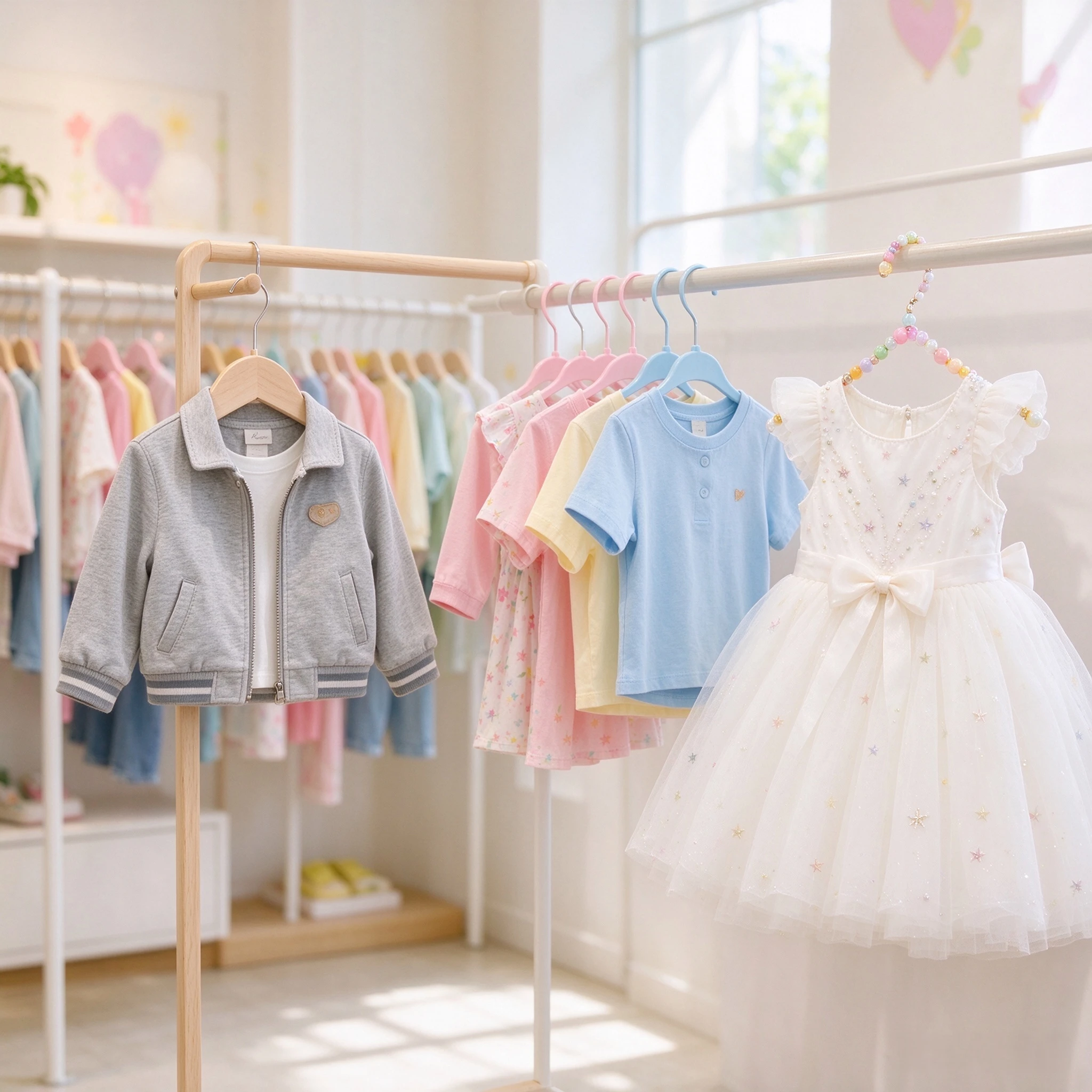
Children’s clothing is one of the fastest-growing segments of apparel retail — and it is also one of the most mismanaged when it comes to display. Walk through almost any kids’ department and you will see it: tiny garments stretched on adult hangers, shoulders poking out of proportion, sleeves slipping off, and little dresses collapsing into piles. The problem is simple — most stores treat children’s clothing like adult clothing, and most parents do the same at home. But kids’ garments have different proportions, different weights, and different needs. The right kids clothes hangers protect the garment, display it beautifully, and make a small item look intentional and premium. In this complete guide, we cover children’s hanger sizes by age, the best materials for kids’ clothing, safety considerations, display strategies for children’s stores, and wholesale buying advice for retailers.
Inhoudsopgave
Why Kids Clothes Hangers Are Different
Children’s clothing is not simply a smaller version of adult clothing, and kids clothes hangers are not simply smaller adult hangers. There are four fundamental differences that shape how you should choose hangers for children’s garments:
- Proportions. Children’s garments have different shoulder-to-body ratios than adult clothing. A toddler’s jacket has a narrow, sloping shoulder line — an adult hanger stretches the shoulders out of shape and creates ugly bumps. Hangers must match the child’s shoulder width, not just the garment’s length.
- Lightweight fabrics. Most kids’ clothing uses lighter fabrics than adult wear. Slippery jersey, delicate cotton, and soft knits slide off smooth hangers easily, so grip and non-slip surfaces matter more at small sizes.
- Rapid sizing turnover. Children outgrow clothing quickly, which means display needs change fast. Retailers re-merchandise kids’ departments frequently, so a flexible hanger system that can move between sizes is valuable.
- Safety sensitivity. Hangers for children’s clothing may end up in children’s hands — in fitting rooms, in stores, and at home. Sharp edges, brittle plastic that snaps into shards, and small detachable parts are all hazards that adult hanger selection does not need to consider as seriously.
The result: choosing the right kids clothes hangers is about matching size, material, and safety to a very specific garment category. It is also a merchandising opportunity — coordinated, correctly sized hangers make a children’s department look professional, colorful, and easy to shop. For a full overview of every hanger family, see our guide to soorten kledinghangers.
Kids Hanger Sizes by Age
The single most common mistake in children’s apparel display is using hangers that are too wide. A hanger that is even 5cm too wide visibly distorts a child’s garment — shoulders jut out, the neckline gapes, and the item looks poorly made. Here is the age-based sizing guide that children’s retailers use:
Newborn and Baby (0-12 Months)
Baby garments — onesies, rompers, tiny shirts, and delicate dresses — need hangers of 25-30cm. At this size, non-slip surfaces are essential because baby fabrics are among the most slippery. Lightweight plastic or velvet-covered hangers are ideal; decorative options suit gift displays. Our 20cm pearl hangers for baby clothes are a popular choice for newborn gift displays and baby boutiques.
Toddler (1-3 Years)
Toddler sizes (2T-4T) call for cURL Too many subrequests by single Worker invocation. To configure this limit, refer to https://developers.cloudflare.com/workers/wrangler/configuration/#limits hangers. This is the size range where most damage happens in retail — toddlers’ jackets and sweatshirts are thicker, but the shoulders are still narrow. Wide-shoulder plastic hangers or lightweight wooden hangers with a non-slip bar work best for the heavier items.
Young Child (4-7 Years)
Children’s sizes (5-7) use 33-38cm hangers. This is the most common size band for school uniforms, dresses, and jackets — the range where children’s stores carry the deepest inventory. A mix of standard plastic hangers for everyday items and sturdier hangers for outerwear works well here.
Older Child (8-14 Years)
Junior sizes (8-16) approach adult dimensions and use 38-42cm hangers — but they are still lighter and narrower-shouldered than adult garments. A 40cm standard hanger usually fits this band. For children’s coats and heavier outerwear, our kids coat hangers in big sizes are designed to carry heavier garments without losing the child-size fit.
Best Kids Hanger Materials
Each material brings different strengths to children’s clothing display. Here is how the options compare for kids:
Plastic Kids Hangers
The retail workhorse for children’s departments. Plastic kids hangers are lightweight, durable, affordable, and available in a full spectrum of bright colors that suit children’s merchandising. Choose quality ABS or PP material — cheap molded plastic can snap and splinter. For everyday shirts, tops, and dresses, a coordinated set of pastel or bright plastic hangers creates an instantly professional display. See our complete guide to plastic kledinghangers for material grades. For bulk retail buying, our bulk kinder kledinghangers met dwarsstang are designed for children’s clothing stores stocking full ranges.
Wooden Kids Hangers
Wooden hangers bring warmth and premium feel to children’s departments — especially for coats, suits, and special-occasion wear. Lightweight birch or rubberwood hangers in small sizes are gentle on narrow shoulders and project quality. Wooden hangers are also the top choice for boutiques that photograph their kids’ collections. See our full guide to houten hangers for finishes and applications.
Velvet and Non-Slip Kids Hangers
Velvet-covered hangers are the answer for slippery kids’ fabrics — jersey tees, satin party dresses, and fine knits. The soft surface grips the fabric, prevents slippage, and protects delicate loops and textures. Velvet hangers in pastel colors are increasingly popular in premium children’s stores. See the comparison in fluwelen vs plastic hangers.
Decorative and Beaded Kids Hangers
For gift sections, party-wear displays, and children’s boutiques, decorative hangers turn the hanger into part of the visual story. Beaded and pearl hangers add charm to dresses and special-occasion outfits, and they photograph beautifully. Our beaded kids pants hangers with clips combine decoration with function for children’s trouser display. See the full guide to parelhangers for more decorative options.
Hangers by Children’s Garment Type
Matching the hanger to the garment is the fastest way to improve any children’s department. The professional guideline:
- Onesies and bodysuits: 25-28cm plastic hangers with a non-slip surface; hang by the shoulders.
- T-shirts and tops: 30-33cm standard plastic hangers in coordinated colors.
- Dresses: 30-35cm hangers with notched shoulders to keep straps in place; velvet for party dresses.
- Pants and jeans: 30-35cm clip hangers or hangers with a trouser bar; beaded clip options add charm.
- Jackets and sweatshirts: 33-38cm wide-shoulder hangers (plastic or wooden) that support the shoulder line.
- Coats: 38-42cm heavy-duty hangers; children’s coat hangers in big sizes for the heaviest items.
- School uniforms: standard 33-38cm plastic hangers; consistent color makes uniform rails look orderly.
- Special occasions (christening, parties): decorative pearl and beaded hangers that double as keepsakes.
Safety Considerations for Children’s Hangers
Because children’s hangers can end up in little hands, safety deserves more attention than in adult display:
- No sharp edges. Check that hooks, clips, and shoulders are smooth and rounded. Avoid hangers with rough mold lines or exposed metal ends.
- No small detachable parts. Decorative elements — beads, pearls, clips — must be firmly attached. If a bead can be pulled off, it is a choking hazard. Buy from manufacturers who test attachment strength.
- Quality material only. Cheap brittle plastic can snap under load and create sharp shards. Specify ABS or quality PP for kids’ hangers.
- Non-toxic finishes. For wooden hangers, confirm the paint, stain, or lacquer is child-safe and free of harmful substances — relevant when hangers travel home with the garment.
- Weight-appropriate. Never overload a child-size hanger. Its load rating is lower than an adult hanger; matching size to garment weight prevents breakage.
When sourcing kids clothes hangers in bulk, ask your supplier for material certificates and finish safety documentation — a professional children’s supplier should provide both without hesitation.
Quick Reference: Kids Hanger Sizes
For fast decision-making when setting up a children’s department or buying hangers for your own kids’ wardrobe, here is the quick-reference table:
| Age Band | Clothing Size | Hanger Width | Recommended Type |
|---|---|---|---|
| Baby (0-12m) | 0-3M to 18M | 25-30cm | Lightweight plastic or velvet; non-slip surface; decorative for gifts |
| Toddler (1-3y) | 2T-4T | cURL Too many subrequests by single Worker invocation. To configure this limit, refer to https://developers.cloudflare.com/workers/wrangler/configuration/#limits | Wide-shoulder plastic; lightweight wood for jackets |
| Young child (4-7y) | 5-7 | 33-38cm | Standard plastic; clip hangers for pants; sturdier for outerwear |
| Older child (8-14y) | 8-16 | 38-42cm | Standard 40cm; heavy-duty kids hangers for coats |
Golden rule: if the garment’s shoulders do not reach the hanger’s ends, the hanger is too wide. A correct kids hanger is fully covered by the garment’s shoulder seam, with no plastic or wood visible beyond the fabric.
Using Kids Hangers at Home
Parents shopping for their children’s wardrobes face the same size-matching problem — usually with worse results. The classic family wardrobe starts with adult hangers handed down from the parents’ closet, and a child’s shirts stretch, slip, and crumple for years before anyone realizes the hangers are the problem.
Build a kids-only section. Dedicate a wardrobe rail to the children with correctly sized hangers per age band. Sort by type: hang shirts and tops on 30-33cm plastic hangers, dresses on notched or velvet hangers, pants on clip hangers, and jackets on wide-shoulder hangers. As children grow, swap the whole rail to the next size band — a ten-minute task that protects the clothes you buy.
Hang what deserves hanging. Not everything needs a hanger. Heavy knits and sweaters should be folded — hangers stretch them out of shape at any age. Reserve hangers for items that keep their shape: shirts, dresses, jackets, pants, and special-occasion wear. For school uniforms, a consistent set of hangers makes the morning routine faster and keeps the uniform ready.
Safety at home. The same safety rules apply at home: smooth edges, firmly attached decorative parts, and quality material. Keep decorative hangers out of reach of small children when not in use, and replace any hanger that shows cracks or sharp breakage immediately — a damaged hanger is a hazard and will eventually damage the garment.
Display Strategies for Children’s Stores
The best kids clothes hangers in the world only help if the display works. Proven strategies from successful children’s retailers:
- Color-code by size or category. Assign each size band a hanger color (e.g., pastel pink for baby, yellow for toddler, green for young child). Customers and staff can find the right size at a glance, and the rail looks organized from across the store.
- Keep lower rails reachable. Children’s departments are shopped by adults but loved by children. Keep the most colorful and appealing items at adult eye level; use lower rails for impulse and touchable items.
- Front-face hero items. For party dresses and special pieces, use decorative hangers on front-facing fixtures where the hanger itself contributes to the look.
- Standardize on one system. As with adult retail, a single coordinated hanger system — one material family, one color logic — reads as premium. Mixing leftover hangers from different suppliers looks messy at any price point. See our complete guide to hangers for retail stores for storewide display strategy.
- Update sizes as ranges change. When a size band sells through, return its hangers to the back room and re-issue to the new size rather than mixing sizes on one rail.
Bulk Buying Kids Hangers for Retail
For retailers and wholesalers, buying kids clothes hangers in bulk is a straightforward process — if you know the right questions to ask:
Plan quantities by size band. Estimate your display garments per size, then multiply by 1.2-1.5 for fitting rooms, spares, and turnover. A store displaying 1,000 children’s items typically needs 1,200-1,500 hangers across 3-4 size bands. Order the full size mix in one go so colors match exactly.
Specify material and finish. Tell your supplier: material (ABS, PP, rubberwood), hanger width per size band, hook style (swivel vs fixed), color codes (PMS or Pantone), and any logo printing requirements. For kids’ lines, also request safety documentation.
Consider branding. Children’s stores benefit strongly from logo hangers — the hanger travels home with the garment and reinforces the brand. Logo printing MOQ is typically 1,000 pieces per design. For the full customization picture — costs, MOQs, lead times — see our guide to custom clothes hangers (OEM/ODM).
Buy factory-direct. Purchasing directly from a hanger manufacturer saves 15-30% versus distributors and guarantees consistent color and quality across all sizes and materials. A multi-material manufacturer lets you consolidate plastic, wooden, velvet, and decorative hangers in one order — one shipping cost, one color standard, one quality level. Always request physical samples of every size band before placing a bulk order: verify the shoulder width against real garments, check the material rigidity by hand, and confirm colors match your store’s palette exactly. A sample set of a dozen hangers costs little and prevents a costly mismatched shipment.
Common Kids Hanger Mistakes
Avoid these frequent errors that cost children’s retailers money and presentation quality:
- 1. Using adult hangers. The most common mistake by far. Adult hangers stretch shoulders, distort necklines, and make kids’ clothing look oversized and damaged.
- 2. One size for all kids. A 2T dress and a size 10 jacket cannot share a hanger width. Mixing sizes on one hanger type damages garments and looks unprofessional.
- 3. Buying the cheapest plastic. Low-grade plastic snaps into sharp shards, damages garments, and fails under the weight of jackets. The small saving per hanger is not worth the damage.
- 4. Ignoring slippage. Kids’ knits and jerseys slide off smooth hangers constantly, leaving tangled rails. Non-slip and velvet surfaces pay for themselves in tidiness.
- 5. Overlooking decorative safety. Loose beads or clips on decorative hangers are a safety risk and a returns headache. Verify attachment quality before ordering.
- 6. Not buying spares. Kids’ departments see heavy handling. Order 15-20% spares so broken hangers can be replaced the same week.
Veelgestelde Vragen
Q: What size hanger should I use for children’s clothes?
A: Match the hanger to the age band: 25-30cm for babies (0-12 months), 30-33cm for toddlers (1-3), 33-38cm for young children (4-7), and 38-42cm for older children (8-14). The shoulder width of the hanger matters more than the length — it should match the garment’s shoulder seam.
Q: Are wooden hangers good for kids’ clothes?
A: Yes, for coats, suits, and premium or special-occasion items. Lightweight wooden hangers in small sizes support narrow shoulders and project quality. For everyday children’s items, quality plastic is more practical and affordable — most stores use wood selectively.
Q: How many hangers does a children’s store need?
A: Multiply your display garment count by 1.2-1.5. A store displaying 1,000 children’s items typically needs 1,200-1,500 hangers, divided across size bands. Keep 15-20% as spares for the heavy handling kids’ departments receive.
Q: What is the safest hanger for children’s clothing?
A: Hangers with smooth rounded edges, no small detachable parts, and non-toxic finishes. Choose quality ABS plastic or finished wooden hangers from a manufacturer who can provide safety documentation. For decorative hangers, verify beads and clips are firmly attached.
Q: Should kids’ hangers be different colors?
A: Coordinated colors are a powerful merchandising tool. Many children’s retailers color-code by size band or category so customers find sizes instantly. Bright and pastel palettes suit children’s departments; the key is consistency — one color system from one supplier.
Q: Where can I buy kids clothes hangers in bulk?
A: Buy factory-direct from a hanger manufacturer. Factory-direct sourcing cuts out distributor margins (saving 15-30%), guarantees color consistency across sizes, and lets you consolidate plastic, wooden, velvet, and decorative hangers in one order. Ask for samples, safety documentation, and itemized quotes before committing.
Q: Do I need special hangers for baby clothes?
A: Yes — baby garments need the smallest hangers (25-30cm) with non-slip surfaces, because newborn fabrics are especially slippery and narrow-shouldered. Lightweight plastic or velvet hangers are ideal; decorative pearl options suit gift displays and baby boutiques.
Q: Can I put logos on children’s hangers?
A: Yes. Logo printing is available on plastic (silk-screen or pad-print), wooden (laser engraving or foil), and velvet hangers, typically from 1,000 pieces per design. Children’s stores benefit strongly from branded hangers because they travel home with the garment and keep advertising the brand. See our guide to custom clothes hangers for details.
Q: How often should I replace kids hangers as my child grows?
A: Replace the wardrobe rail hangers at each size-band transition — roughly every 2-3 years, or when the current hanger’s shoulder width no longer matches the garment’s shoulder seam. In retail, review hanger sizes whenever you re-merchandise a department or receive new size ranges. Quality kids hangers last for years, so the cost is spread over a long service life; the visible benefit is that garments always fit their display correctly.
Dress Kids’ Clothes Right
Children’s clothing deserves hangers that fit it — literally. The right kids clothes hangers protect delicate garments, display them beautifully, and help customers find the right size instantly. It is one of the most affordable upgrades a children’s retailer can make, and it changes how the whole department feels.
At HUIYAO, we have manufactured hangers for children’s clothing since 2002. We supply plastic, wooden, velvet, and decorative kids hangers in every size band — available in coordinated colors and with custom branding — so you can build a complete, consistent children’s hanger system from one factory. We offer free samples, accept trial orders, and provide factory-direct wholesale pricing.
Ready to dress kids’ clothes right? Contact us for:
- Free kids hanger samples across sizes and materials
- A size-by-size hanger plan for your store’s age bands
- Coordinated color and branding consultation
- Safety and material documentation for children’s products
Get a Free Kids Hanger Quote and Samples
Factory-direct pricing · Free samples · All sizes & materials · Child-safe finishes
Voor meer gidsen over het kopen van hangers en branche-inzichten, bekijk onze volledige collectie hanger-gidsen.